
Project Outcomes
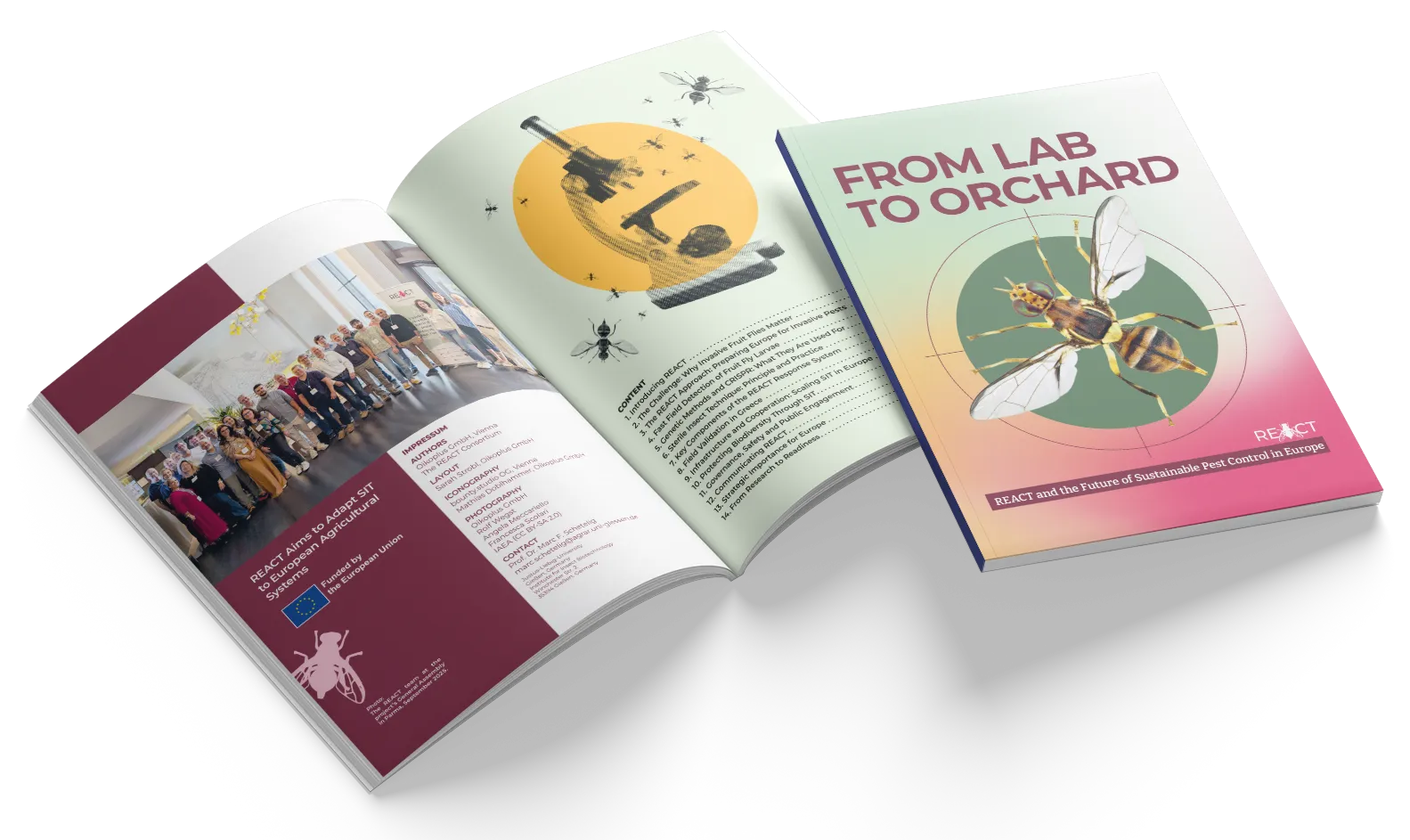
From Lab to Orchard
The REACT Layman Report
Our Report “From Lab to Orchard” explains the REACT project – its questions, methods and results – in clear language for a general audience beyond science. It follows the journey from laboratory research to real-world application in the orchard, showing how the Sterile Insect Technique can help control invasive fruit flies without relying on chemical pesticides.
Publications
Koskinioti, P., Papadogiorgou, G., Rodovitis, V. G., Prekas, P., Bali, E.-M., Giannatos, G., Kagadis, G., Avgoustinos, A., Tsiamis, G., & Papadopoulos, N. (2026).
Enterobacter supplement and ambient conditions determine the performance of sterile male Mediterranean fruit flies. In Physiological Entomology (pp. 1–12).
Wiley Online Library.
Peng, P.-S., Häcker, I., Gao, J.-H., Rehling, T., Petermann, S., Wang, J.-J., Schetelig, M. F., Jiang, H.-B. and Yan, Y. (2025).
Non-lethal genotyping in Drosophila suzukii, Zeugodacus cucurbitae, Bactrocera dorsalis, and Aedes aegypti for functional genomics and genetic control.
Èntomol. Gen. 45, 1699–1708.
Practice Abstracts
Rapid-Deploy Modular Small-Scale Rearing Facilities for Local Sterile Insect Technique Responses to Invasive Fruit Flies
Practitioners in Europe often face sudden, local outbreaks of invasive fruit flies. While the Sterile Insect Technique (SIT) is highly effective, it typically relies on large, centralized mass-rearing facilities that are costly, slow to implement, and poorly suited for rapid, local containment.
The REACT project developed and validated an innovative small-scale, modular rearing facility concept that can be set up near an outbreak area and produce sufficient numbers of high-quality sterile males for early containment and SIT eradication actions. The facility requires about 35 m² and is organized into functional rooms for (1) adult rearing and egg collection, (2) larval development and pupation, (3) diet preparation and quality control, and (4) washing and storage. Using established rearing protocols and genetic sexing strains, the facility can produce up to a few hundred thousand sterile males per week, depending on operational settings.
To keep investment and complexity low, the concept relies on standard laboratory equipment, simple climate control, and external irradiation services rather than installing irradiation on site. 3D printing was used to create adult rearing cages and quality-control devices that fit a limited space. Enhanced larval diets, including symbiotic bacteria-derived supplements, were integrated into routine rearing and improved male quality.
In practice, this concept allows local SIT deployment with shorter transport distances and greater operational flexibility. For end-users and responsible authorities, the main benefits are faster start-up for local containment and better integration of SIT into regional pest management and contingency planning.
Geographical Location
Greece
Additional information
The main cost items are the dedicated space (≈35 m²), basic climate control, standard lab equipment and consumables, and access to an external irradiation service.
On-site detection of invasive fruit fly larvae using a portable CRISPR-based identification kit
Invasive fruit flies can establish rapidly and cause major crop and trade losses. For inspectors and field teams, the main bottleneck is fast, reliable larval identification at the point of interception: larval morphology is difficult and requires expert staff, while standard molecular methods are slower and depend on laboratory infrastructure. The REACT project addressed this gap by developing a rapid, portable identification workflow for priority species, including Bactrocera dorsalis, Bactrocera zonata, and Ceratitis capitata.
REACT delivered a Prototype Interception Kit (PIK) based on CRISPR/Cas12. The kit combines (1) a simple DNA extraction protocol for pooled larval samples, (2) species-specific guide RNAs, and (3) fluorescence readout. This enables on-site molecular identification at border inspection points or in the field within a short timeframe, without advanced laboratory equipment. In validation with 100 field samples, the method achieved about 97% agreement with DNA barcoding, showing high reliability for operational use.
Practical implications for end-users are immediate. Inspectors and surveillance teams can screen suspect larvae on site and make faster decisions on containment, shipment handling, and delimiting surveys, reducing delays and the risk of pest establishment. The PIK is packaged in a robust wheeled case for easy deployment; reagents are stored at 4 °C, compatible with standard cooling boxes. A dedicated washing protocol reduces contamination when testing multiple larvae from a single fruit.
Key benefits are faster response, fewer shipments held while awaiting lab results, and earlier outbreak containment, reducing downstream control costs. Main costs relate to kit procurement, consumables, and brief user training. Overall, the PIK offers a practical, scalable way to increase inspection capacity and protect production and market access by distinguishing high-risk invasive species from non-target fruit flies in real time.
Public Deliverables
Find scientific results from the REACT project on