

19 Nov 2025
In the article “Neoclassical development of genetic sexing strains for insect pest and disease vector control”, published in Insect Science (2025), Giovanni Petrucci, Maria‑Eleni Gregoriou, Philippos Aris Papathanos, Marc F. Schetelig, Zhijian Tu, and Kostas Bourtzis tackle the difficulty of creating stable, scalable Genetic Sexing Strains (GSS) using classical genetics alone. The authors propose a transformative “neoclassical genetic approach” integrating CRISPR/Cas9-based gene editing, comparative genomics, and targeted rescue strategies. This method enables fast, precise development of sexing markers, offering a broadly applicable framework for next‑generation SIT solutions in agriculture and vector control.
The Sterile Insect Technique (SIT) has long been a cornerstone of area-wide pest control: sterilized males are mass-released to mate with wild females, thereby halting reproduction and gradually suppressing pest populations. However, its success depends on one critical component: the ability to reliably separate male and female insects, ideally before they emerge.
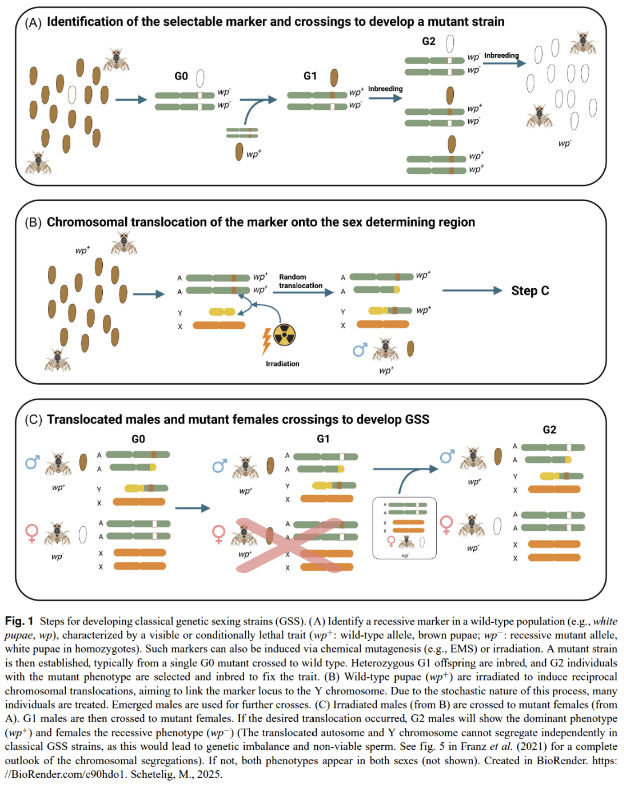
Traditional methods to create Genetic Sexing Strains (GSS) relied on random mutagenesis and chromosomal translocations—a laborious, time-consuming, and species-specific process. In their new article, Petrucci et al. propose a “neoclassical” approach: combining classical genetic concepts with modern molecular tools like CRISPR/Cas9, comparative genomics, and targeted rescue strategies.
This method begins with identifying a reliable marker (e.g., white pupae), then introducing precise mutations in the target species, and finally linking the wild-type (rescue) version of the gene to a male-specific chromosome region. The result? Rapid, stable, and scalable GSS lines for SIT applications—potentially across multiple pest and vector species.
By shifting from stochastic breeding to rational design, this neoclassical approach could reshape how we develop genetically guided insect control systems in agriculture and public health.
Read the article here: https://zenodo.org/records/17630059
Lorem ipsum dolor sit amet, consectetur adipiscing elit. Ut elit tellus, luctus nec ullamcorper mattis, pulvinar dapibus leo.