Close
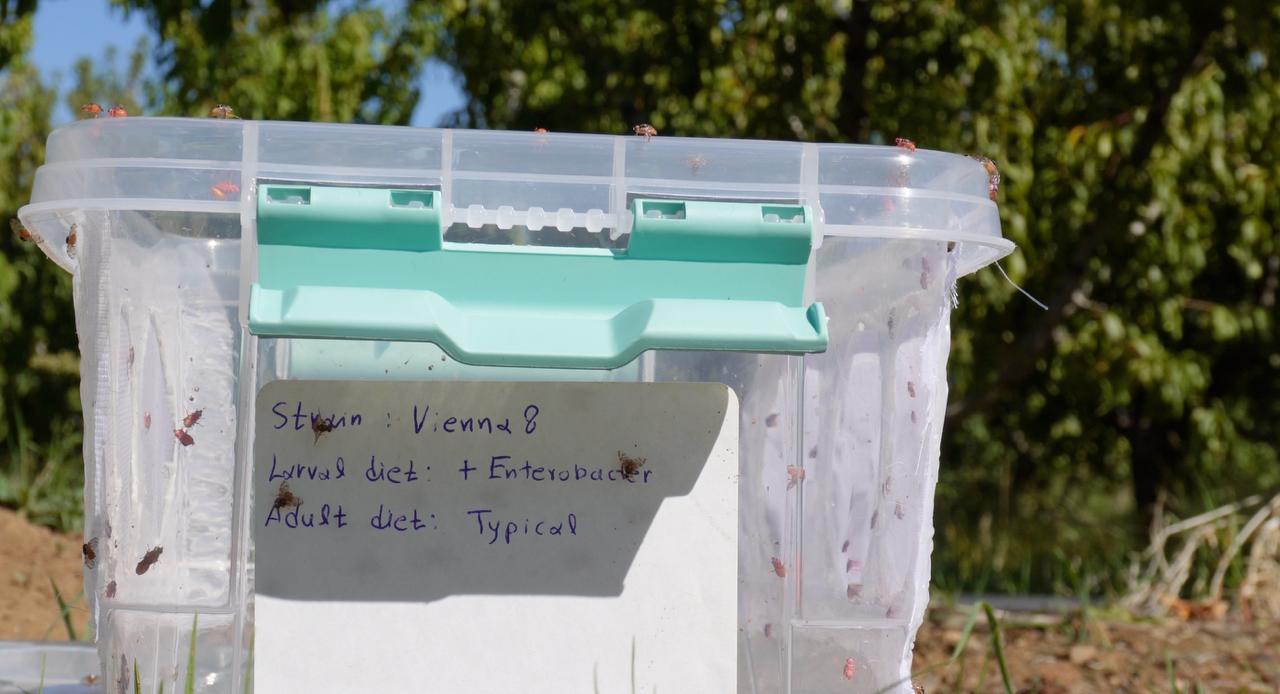
Plastic box containing sterile fruit flies
Test release of sterile fruit flies in Naousa, Greece.
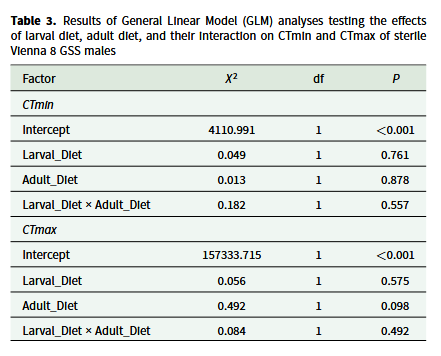
Figure1 - Chart
General Linear Model (GLM) analysis of critical thermal limits (CTmin and CTmax) in sterile Vienna 8 GSS males. Neither larval diet, adult diet, nor their interaction significantly affected thermal tolerance, indicating that Enterobacter supplementation did not alter the upper or lower thermal limits of sterile Mediterranean fruit flies under the tested conditions. Copyright: Papadogiorgou, 2026.

Enterobacter-Based Diets Influence Thermal Recovery of Sterile Mediterranean Fruit Flies: New Scientific Publication

15 June 2026

The REACT project is pleased to highlight a new peer-reviewed scientific publication investigating how microbial dietary supplements affect the thermal performance of sterile Mediterranean fruit flies (Ceratitis capitata), one of the world’s most important agricultural pests. The study was published in the Bulletin of Entomological Research and received support from the European Union’s Horizon Europe REACT project.


The article, titled “Enterobacter-based dietary supplements in both larvae and adult diet affect thermal response of sterile males”, examines whether adding Enterobacter biomass to larval and adult diets can improve the ability of sterile males to cope with temperature stress. Thermal resilience is an important factor in Sterile Insect Technique (SIT) programmes, as released insects must remain competitive under varying environmental conditions.


Researchers compared standard diets with Enterobacter-enhanced diets and measured critical thermal limits as well as chill-coma recovery times. While dietary supplementation did not significantly alter the upper or lower thermal limits of sterile males, it did affect recovery from cold stress. Interestingly, sterile males reared on the standard larval diet recovered faster from chill-coma than those reared on the supplemented diet. The study also found notable differences between sterile and wild males, highlighting the importance of understanding thermal performance when optimising SIT programmes.


The findings contribute to ongoing efforts to improve the effectiveness of environmentally friendly pest management strategies and provide new insights into the complex interactions between nutrition, microbiota, physiology, and insect performance under thermal stress.


Publication:
Papadogiorgou, G., Koskinioti, P., Rodovitis, V., Giannatos, G., Augustinos, A., Tsiamis, G., & Papadopoulos, N. (2026). Enterobacter-based dietary supplements in both larvae and adult diet affect thermal response of sterile males. Bulletin of Entomological Research.


🔗 Read Zenodo: https://zenodo.org/records/20658483

Lorem ipsum dolor sit amet, consectetur adipiscing elit. Ut elit tellus, luctus nec ullamcorper mattis, pulvinar dapibus leo.

Call for Abstracts

10th IOBC-WPRS Working Group Meeting

Innovative Pest Control: Shaping the Future of Sustainable Agriculture

10th IOBC-WPRS Working Group Meeting

DATE

22.–24. Nov 2026

LOCATION

OAC, Chania, Crete

The IOBC-WPRS Working Group “Modern Biotechnology in Integrated Plant Production” invites you to a joint meeting held in collaboration with the EU-funded project REACT.

Submit your abstract now → Register for the conference →

MORE INFORMATION: iobc-wprs.react-insect.eu